
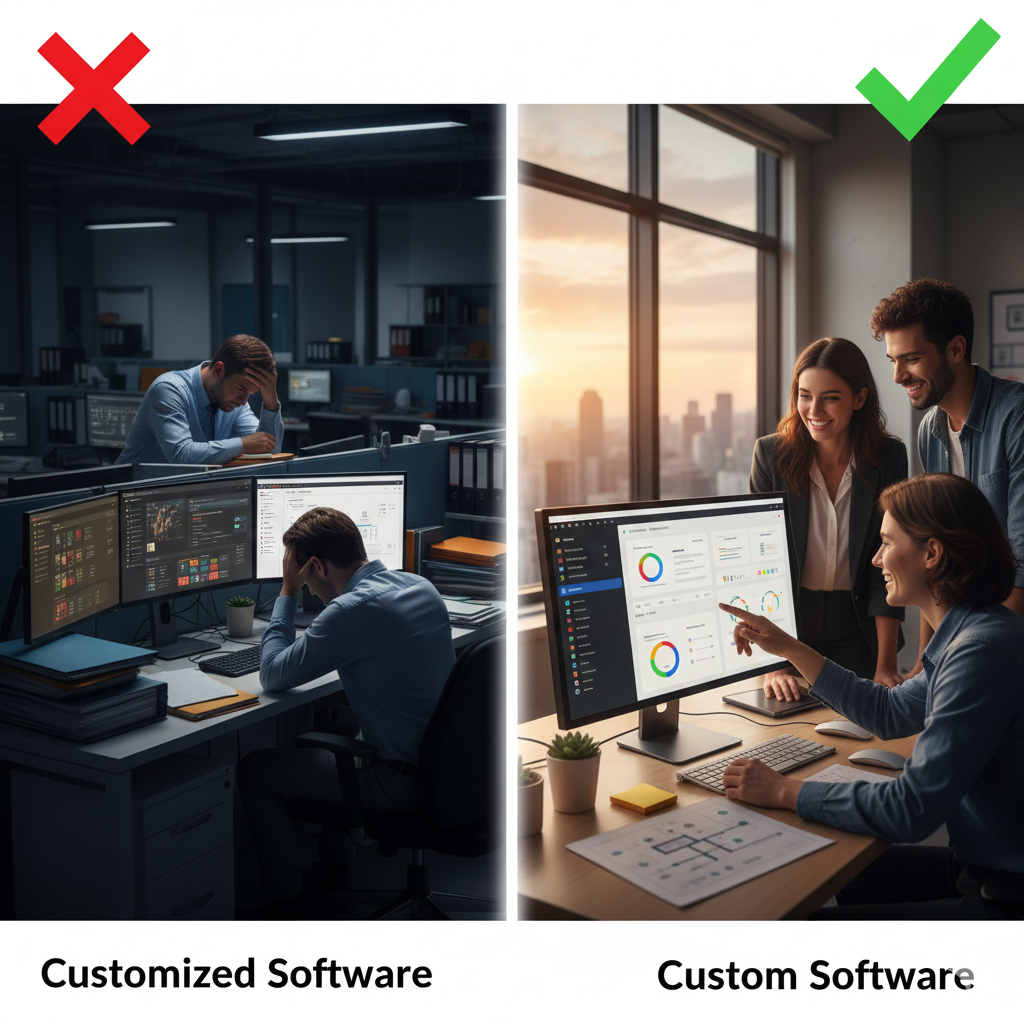

In today’s fast-paced digital landscape, businesses are constantly seeking software solutions that streamline operations, enhance productivity, and provide a competitive edge. When it comes to software, two terms often create confusion: custom software and customized software. While they might sound similar, they cater to very different business needs and come with unique advantages, limitations, and costs. Understanding these differences is critical for making the right technology investment.
1. What is Custom Software?
Custom software is a completely tailor-made solution designed from scratch to address the specific needs of an organization. It is built from the ground up, ensuring that every feature, functionality, and interface aligns perfectly with the business’s workflows and objectives.
Key Features of Custom Software:
- Built specifically for your business requirements
- Fully scalable and adaptable to future needs
- Offers unique functionalities not available in off-the-shelf products
- High level of control over performance, security, and updates
Example: A logistics company develops a custom software platform to manage fleet operations, real-time tracking, route optimization, and warehouse inventory management—all integrated seamlessly into a single system.
2. What is Customized Software?
Customized software, on the other hand, is an existing software product that is modified or enhanced to better suit a business’s requirements. This approach involves adding features, adjusting workflows, or integrating third-party tools, but it relies on a pre-built foundation.
Key Features of Customized Software:
- Modifications are made to an existing software platform
- Cost-effective compared to full custom development
- Faster implementation and deployment
- Limited in flexibility compared to fully custom solutions
Example: A company uses a popular Customer Relationship Management (CRM) system and customizes dashboards, reports, and workflow automation to meet its unique sales process.
3. Custom Software vs. Customized Software: Side-by-Side Comparison
| Feature | Custom Software | Customized Software |
|---|---|---|
| Development | Built from scratch | Modified from existing software |
| Cost | Higher initial cost | Lower initial cost |
| Timeline | Longer development cycle | Faster deployment |
| Flexibility | Fully adaptable | Limited by original software |
| Scalability | Highly scalable | Dependent on base software |
| Maintenance | Controlled by owner | May rely on vendor updates |
| Unique Needs | Fully addressed | Only partially addressed |
This table clearly illustrates that custom software is ideal for businesses with unique processes, while customized software suits organizations that want faster deployment with some level of personalization.
4. Advantages of Custom Software
- Tailored to your exact business needs – nothing is wasted or unnecessary.
- Competitive advantage – unique software can differentiate your business.
- Better integration – seamlessly integrates with existing systems.
- Scalability – designed to grow as your business expands.
- Full control – over functionality, design, and security protocols.
5. Advantages of Customized Software
- Cost-effective – typically cheaper than building from scratch.
- Faster deployment – as it modifies existing platforms.
- Familiarity – users may already know the base software.
- Reliable vendor support – often comes with updates and support options.
- Flexible enhancements – can add features incrementally.
6. Cost Considerations
While custom software is more expensive upfront, it often provides better long-term ROI due to its scalability, performance, and alignment with business goals. Customized software, while initially cheaper, may incur additional costs for future updates or if the base software limits certain functionalities.
7. Choosing the Right Solution for Your Business
When deciding between custom and customized software, consider these factors:
- Business size and complexity: Large enterprises with unique processes benefit more from custom solutions.
- Budget constraints: Small to medium businesses may opt for customized software initially.
- Time to market: Customized software offers faster implementation.
- Long-term goals: If growth and scalability are priorities, custom software is often the better investment.
8. Real-World Applications
- Custom software: A hospital develops a patient management system tailored to its unique departments, appointment schedules, and billing processes.
- Customized software: A retail store uses an e-commerce platform and customizes product pages, shipping workflows, and payment integrations.
9. Common Myths About Custom and Customized Software
Myth 1: Custom software is always too expensive.
Reality: While it has a higher initial cost, the long-term benefits often outweigh the upfront investment.
Myth 2: Customized software is sufficient for all businesses.
Reality: Businesses with unique processes may find it limiting over time.
Myth 3: Custom software takes too long to implement.
Reality: With the right development partner, timelines can be optimized without compromising quality.
10. Conclusion
Choosing between custom and customized software is not about which is better universally—it’s about which aligns with your business goals, budget, and timeline. Custom software offers unparalleled flexibility and a perfect fit for complex business processes, while customized software provides a quicker, cost-effective way to adapt existing tools.
Understanding the nuances of these solutions ensures businesses invest wisely, reduce operational inefficiencies, and future-proof their technology.