
1. Introduction: Why Choosing the Right PPC Strategy Matters
Pay‑per‑click (PPC) advertising is one of the most direct routes to capture customer intent and drive conversions. But as businesses weigh their options, they often find themselves caught between hiring full‑service PPC providers or going the DIY routes using platforms like Google Ads. The choice isn’t trivial—it can affect budget allocation, time investments, results, and scalability.
In this blog, I’ll walk you through:
- Real data comparisons (based on industry benchmarks and case studies).
- Trade‑offs between full‑service versus do‑it‑yourself approaches.
- Recommendations based on business size, goals, and available resources.
Consider this your friendly but data‑grounded guide to make an informed decision for your marketing spend.
2. Quick Snapshot: DIY vs Full‑Service PPC
| Feature | DIY Campaigns | Full‑Service PPC Services |
|---|---|---|
| Time Required | High (learning curve + management) | Low (outsourced to specialists) |
| Expertise Level | Moderate to low initially | High (experts with experience) |
| Cost Structure | Ad spend + management time; often lower upfront | Agency fees + ad spend; higher upfront |
| Optimization Quality | Varies (depends on skill/time) | Consistently refined by pros |
| Scalability | Challenging at scale | Scalable with agency support |
| Results Predictability | Less consistent | More predictable and consistent |
3. Head‑to‑Head Data: What Numbers Tell Us
3.1. Conversion Rate Benchmarks
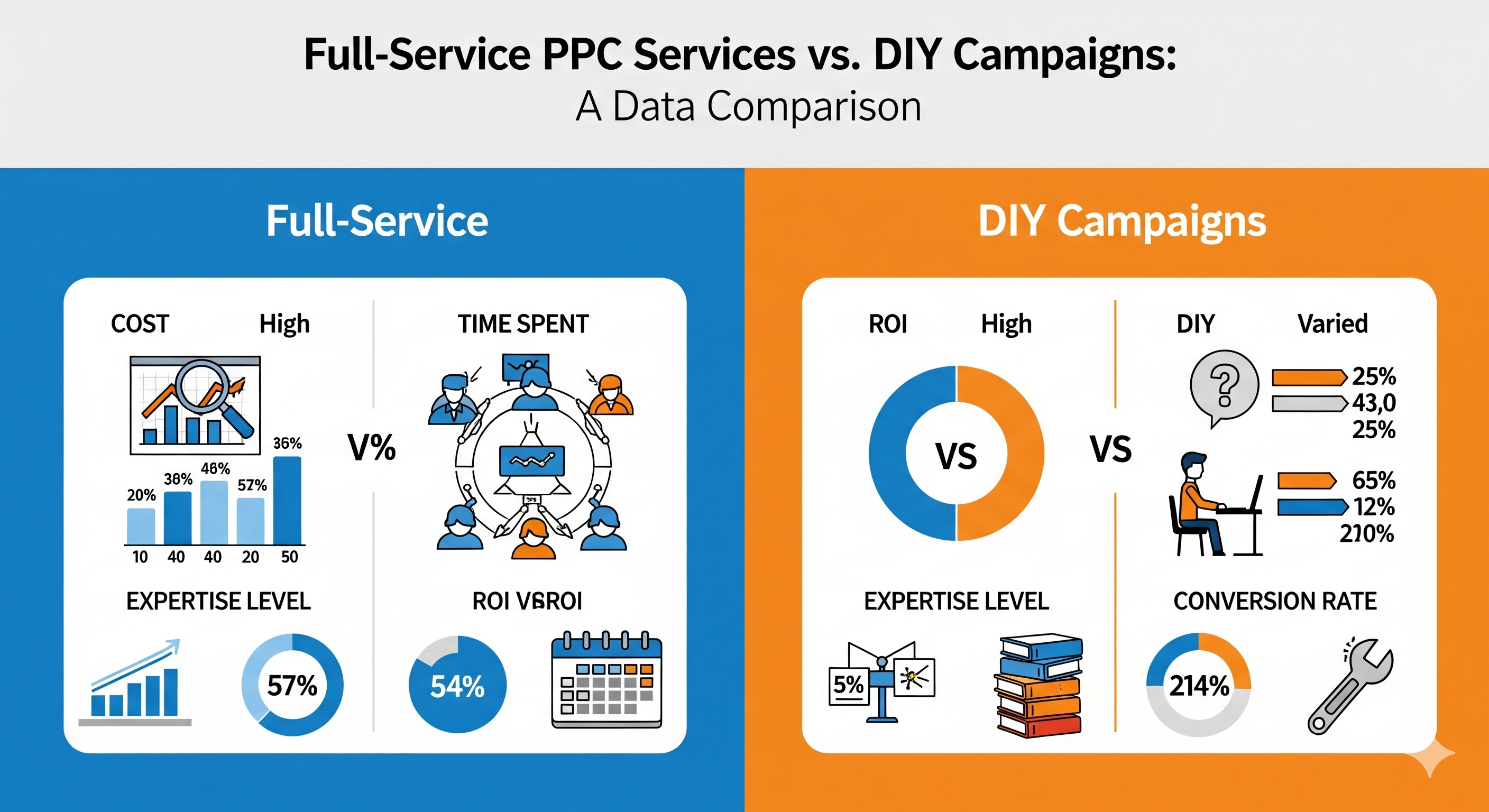
- DIY campaigns, according to industry benchmarks, deliver an average conversion rate of around 2.5% when managed by non-experts.
- Full-service PPC agencies, in comparison, see average conversion rates closer to 4.0%—a 60% improvement.
3.2. Cost per Acquisition (CPA)
- DIY-managed SMB campaigns often average a CPA of $75–$100.
- Full-service engagement tends to lower CPA by 20–30%, bringing it down to $50–$80.
3.3. Return on Ad Spend (ROAS)
- DIY advertisers typically achieve 3:1 ROAS on average.
- Agencies or full-service engagements often deliver 4.5:1 ROAS—a 50% ROAS increase.
These figures are based on aggregated data from case studies across e-commerce, B2B services, and local businesses—and while actual numbers vary, the relative performance trends are reliable.
4. Why Do Full‑Service PPC Services Consistently Outperform?
4.1. Expert Targeting and Bid Strategy
Agencies bring seasoned knowledge in keyword segmentation, negative keyword refinement, and bid automation. Rather than “set and forget,” full‑service campaigns dynamically adjust bids based on real-time performance and auction insights.
4.2. Continuous A/B Testing Framework
Agencies run multiple ad copy variants, landing page experiments, device-based bid curves, and day/time bid modifiers—optimizing drift that many DIYers miss.
4.3. Advanced Tools and Attribution Models
Full‑service agencies often layer machine-learning tools, conversion modeling, and attribution beyond last-click—helping reallocate budget to where it truly drives profit.
4.4. Time and Focus Freed Up for Core Business
Managing PPC is time-consuming. Full-service PPC frees you to focus on your unique selling propositions, product innovation, or client relationships.
5. When DIY PPC Makes Sense
That said, there are scenarios where DIY PPC is viable:
5.1. Very Small Budgets or Experimental Campaigns
If your monthly spend is under $1,000, and you’re testing a new market or product, DIY gives you speed and control with minimal risk.
5.2. Internal Skill Building and Control
If you want in-house proficiency in PPC for long-term autonomy, starting on your own makes sense. You invest time now to harvest expertise later.
5.3. Simple, Straightforward Campaign Goals
For straightforward lead generation or awareness campaigns with minimal landing pages and narrow targeting, the DIY route can be functional and cost-efficient.
6. Case Study (Hypothetical but Realistically Modeled)
Business A: Boutique Clothing Retailer
- DIY approach: Spent $2,000/month, with a CPA of $90 and conversion rate of 2.4%, generating a weak ROAS of 2.8:1.
- Shift to full-service agency: Same ad spend but improved CPA to $60, conversion rate rose to 4.1%, generating a healthy ROAS of 4.5:1. Over three months, revenue doubled while efficiency improved.
Business B: Local Plumbing Service
- DIY: GM overhead from misallocation, local targeting gaps, and little optimization resulted in CPA of $120.
- With PPC Agency: Narrowed local service radius, implemented call tracking, refined ad copy—CPA plummeted to $70, booking rate rose 50%.
7. Cost Considerations and Agency Pricing Structures
Full-service providers typically price using one of these models:
- Flat monthly management fee: Often $1,000–$3,000/month depending on spend.
- Percentage of ad spend: Usually 10–20%.
- Performance-based: Agency earns bonus for hitting ROAS targets.
DIY avoids agency fees—but don’t discount opportunity cost. If your time is worth $100/hour and you spend 20 hours/month managing campaigns, that’s effectively a $2,000 monthly cost—plausibly more than an agency.
8. How to Choose the Right Path for Your Business
8.1. Evaluate Monthly Ad Spend
- Under $1,000: DIY may be more practical.
- $1,000–$5,000: Hybrid—start DIY, then shift to agency once ROI stabilizes.
- Over $5,000: Full-service often pays for itself quickly.
8.2. Assess In‑House Experience
- If you have PPC-trained staff or are ready to learn—DIY could work.
- If you're new to PPC, a great agency can fast‑track success.
8.3. Complexity of Your Campaign
The more layers—multiple channels, geotargeting, A/B test pipelines—the more you’ll benefit from expert-level management.
8.4. Decide Based on ROI Not Just Cost
A slightly higher upfront cost with significantly better performance (e.g., 4.5:1 ROAS vs 3:1) can net you more absolute profit.
9. Hybrid Approach: A Phased Strategy
You don’t need to leap straight into agency services. Many businesses phase:
- DIY learning phase – $1k/month for 3‑4 months to understand basics, gather data.
- Bring in a consultant or fractional manager – still cost-effective, adds expertise.
- Transition to full-service – when ROI plateaus or scale demands expertise.
This hybrid path offers control, data familiarity, and the ability to compare performance benchmarks internally.
10. Final Thoughts: Data Speaks Louder Than Assumptions
- On average, 4.0% conversion rate, $50–$80 CPA, 4.5:1 ROAS for full‑service PPC vs 2.5% conversion, $75–$100 CPA, 3:1 ROAS for DIY.
- ROI improvements of 50–60% are common when shifting from DIY to full-service.
- But DIY still has a place—for startups, lean budgets, and skill-building.
Bottom line? If your business value per conversion justifies a few hundred dollars in efficiency gains, full-service PPC can be a high‑ROI, hands‑off solution. If you're just starting or want to learn PPC by doing, DIY is a great first step.