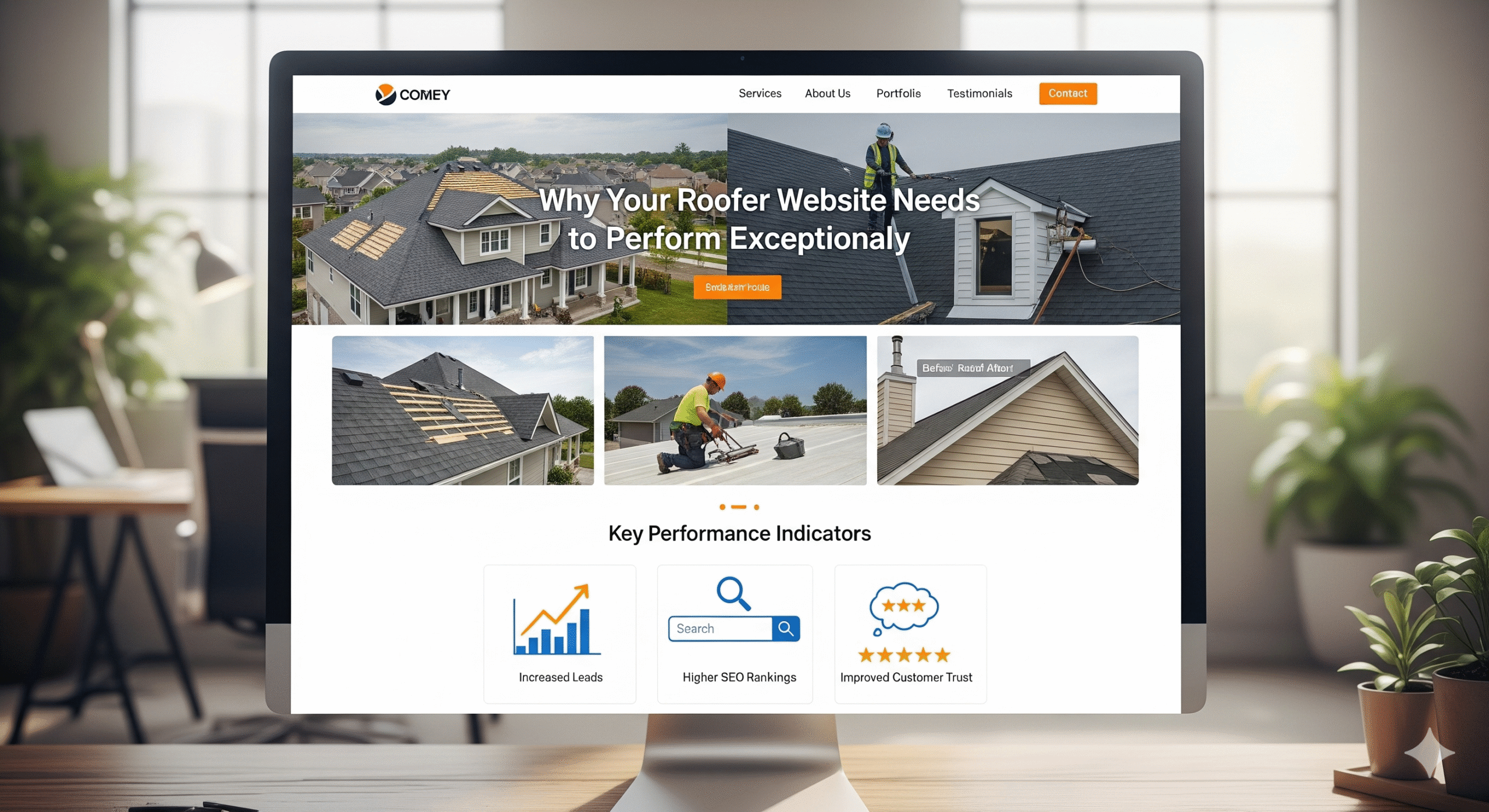

In today’s competitive world, your roofing business isn’t just judged by the quality of your workmanship—it’s judged by the first impression people get online. More than 90% of homeowners start their search for a roofing service online, and if your site doesn’t look polished, load fast, or clearly communicate value, they’ll click away—immediately. That’s why high‑performing roofer websites must combine visual appeal, trust signals, smooth usability, quick loading, and SEO savvy—all wrapped in a genuinely human voice.
2. Long‑Tail Heading: High‑Impact Hero Section with Localized Trust Hooks
The hero section—your site’s first visual real estate—should instantly communicate who you are and why you're the best choice in your service area. Use a clear, high-resolution image or video of your team on a job, with overlay text such as:
“Reliable Roofing Experts Serving [Your Town/Region] – Free Inspections, Fully Licensed & Insured.”
Add a trust badge (e.g., licensed & insured, BBB accredited) near your primary CTA button (“Request Your Free Quote”), and include local service credentials like “Proudly serving Greater [City] since 19XX.”
3. Highlight Your Services with Clarity and Focus
Create a bullet‑style services section right below the hero that clearly enumerates your offerings:
- Residential roof repair & replacement
- Commercial flat roof services
- Storm damage assessment & restoration
- Roof maintenance & preventative care
Each service item should link to a dedicated service page with concise, scannable details, compelling visuals, and a prompt to “Schedule a free quote.”
4. Deep Dive via Long‑Tail Heading: SEO‑Optimized Individual Service Pages
Your service pages are vital SEO drivers and conversion points. For each page:
- Include keyword‑rich headings such as “Emergency Storm Damage Roof Repair in [City]”
- Add descriptive alt text to your images (e.g., “warped shingle replacement in [City] roof”
- Use short, benefit‑oriented paragraphs (“We restore your home’s safety, peace of mind, and curb appeal fast.”)
- Embed internal links to related services and your contact/quote page
Also consider an FAQ subsection, like:
Q: What’s the roof repair turnaround time?
A: Most repairs are completed within 1–3 days, weather permitting.
Answering real homeowner questions builds both trust and SEO value.
5. Long‑Tail Heading: Real Testimonials & Project Galleries That Build Trust
Nothing resonates like proof. Dedicate a section to customer testimonials, each with a real photo or star rating snippet and a concise quote, e.g.:
“Within hours of the storm, their team assessed and patched our roof. Professional, fast, and the clean‑up was flawless.” — Emily G., [City]
Then, embed a gallery of real project photos (before/after shots) with brief, captioned context:
- Before: Missing shingles after hailstorm
- After: Fully restored with upgraded asphalt shingles
Make these galleries scroll‑friendly and mobile‑optimized—let the visuals tell your quality story.
6. Long‑Tail Heading: Mobile-First Design with Lightning Fast Load Times
With over 70% of users on mobile, your site must be responsive and blazing fast. Prioritize:
- Lightweight, lazy‑loaded images
- Minified CSS & JavaScript
- Reliable caching & CDN setup
- Large, tappable buttons (“Free Quote”) with generous spacing — no pinching or zooming needed
Also, implement sticky navigation and make sure your contact button’s visible at all times—especially on long scrolling pages.
7. Contact Page: Simplicity, Accessibility, and Conversion Power
Your contact page should answer one question: “How do I get in touch (and quickly)?” Design it with:
- A simple form (name, address, email, phone, brief message)
- Click‑to‑call phone number (especially for mobile)
- A map embed showing your location—or service area if mobile users need proximity details
- A mini‑FAQ or bulleted list (“What to expect after requesting a quote,” “Our call‑back window,” etc.)
Add trust touches like license number, insurances, and a brief note: “We never share your info—we just call to schedule an inspection.”
8. Long‑Tail Heading: About Us Page That Echoes Your Story & Credentials
Homeowners choose businesses they feel connected to. Craft an About page that includes:
- Your brand’s origin story (“I grew up watching my father restore roofs in our tight‑knit community…”)
- Your team’s certifications and years of experience
- A group photo or candid shots on a job site
- An overlay of key credibility markers (e.g., “Manufacturer-certified shingle installer”)
Close with a short form or CTA: “Meet us in person—Request your inspection today.”
9. What Sets Your Blog/Resources Section Apart (Long‑Tail Heading)
A blog can be a goldmine for SEO and customer education. Focus on value‑packed, location‑relevant topics:
- “How to tell if hail damaged your [CITY] roof”
- “Why spring roof inspections save you thousands in [CITY/REGION] storms”
- “Best energy‑efficient roofing options for tropical climates like [AREA]”
Each post should link to relevant service pages (“Need repairs? Get a free quote.”), which helps both SEO and conversions.
10. Strong Call‑to‑Action (CTA) Placement Throughout
CTAs must feel universal yet personal—not aggressive. Use phrases like:
- “Get your free roof inspection”
- “See what we can do for your home—ask for a quote”
- “Need urgent assistance? Call us now—licenced & ready”
Place them consistently: in the hero, mid‑page between sections, at the end of service descriptions, inside blog posts, and in the footer.
11. Long‑Tail Heading: Accessibility & User‑Friendly Features That Stand Out
Inclusivity isn’t just ethical—it broadens your reach and sets you apart. Ensure:
- Alt text accurately describes visuals (“customer inspecting tiles on new [City] roof”)
- Proper heading hierarchy (H1, H2, H3) for screen readers
- Keyboard‑friendly form navigation
- Readable font sizes, high‑contrast buttons
- Multilingual support, if your service area is diverse (e.g. English + Tagalog in the Philippines)
This not only boosts usability—it signals professionalism and care.
12. Trust, Transparency & Compliance—What Really Builds Confidence
Beyond aesthetics, you want customers to trust you before they meet you. Include:
- License number and applicable certifications
- Insurance disclaimers (“We’re fully insured for your protection”)
- Reviews from third‑party platforms (Google, Facebook)—embed via widget or link
- Privacy policy (especially if you're collecting personal info) and terms on the contact form
- Optionally, video content: a “Meet the team” clip or a “How we work” behind‑the‑scenes short
13. Long‑Tail Heading: Analytics, SEO Plugins, and Continuous Improvement
Your site should evolve, not stay static. Implement:
- Google Analytics + Search Console to monitor traffic and keyword performance
- A tool like Hotjar to see where users scroll, click, or abandon the page
- Regular audits for broken links, outdated testimonials, and image updates
- Quarterly SEO refreshes—update content, add new FAQs, refresh blog topics
Continuous improvements keep performance strong and design fresh.
14. Closing Thoughts: Bringing It All Together in One Cohesive Framework
When you combine:
- A powerful hero section with local-specific trust signals
- Clarity in service pages with SEO‑rich structure
- Genuine testimonial and gallery storytelling
- Mobile‑first responsiveness and speed optimization
- Accessible design and user-friendly features
- Trust features like credentials, policies, and reviews
- A strategic blog, smart calls to action, and ongoing SEO/analytics strategy
—you transform your roofer website from simply “online presence” to a lead-generation engine that reflects the professionalism of your craft, builds trust immediately, and makes contacting you effortless.
Final Takeaway
A high‑performing roofer website isn’t about bells and whistles. It’s about clear communication, human connection, trust-building, and seamless usability. When you optimize each section—from hero to footer—with real images, genuine testimonials, localized language, and smart SEO, you break through the noise and become the trusted choice for local homeowners. Keep it real, keep it focused, and keep it evolving—and your website will deliver far beyond expectations.