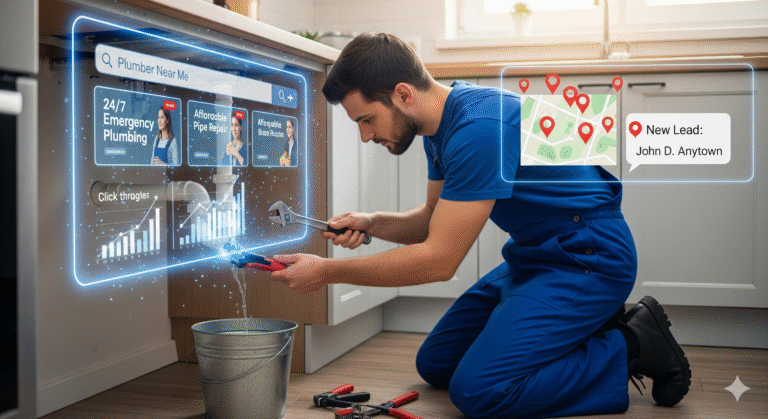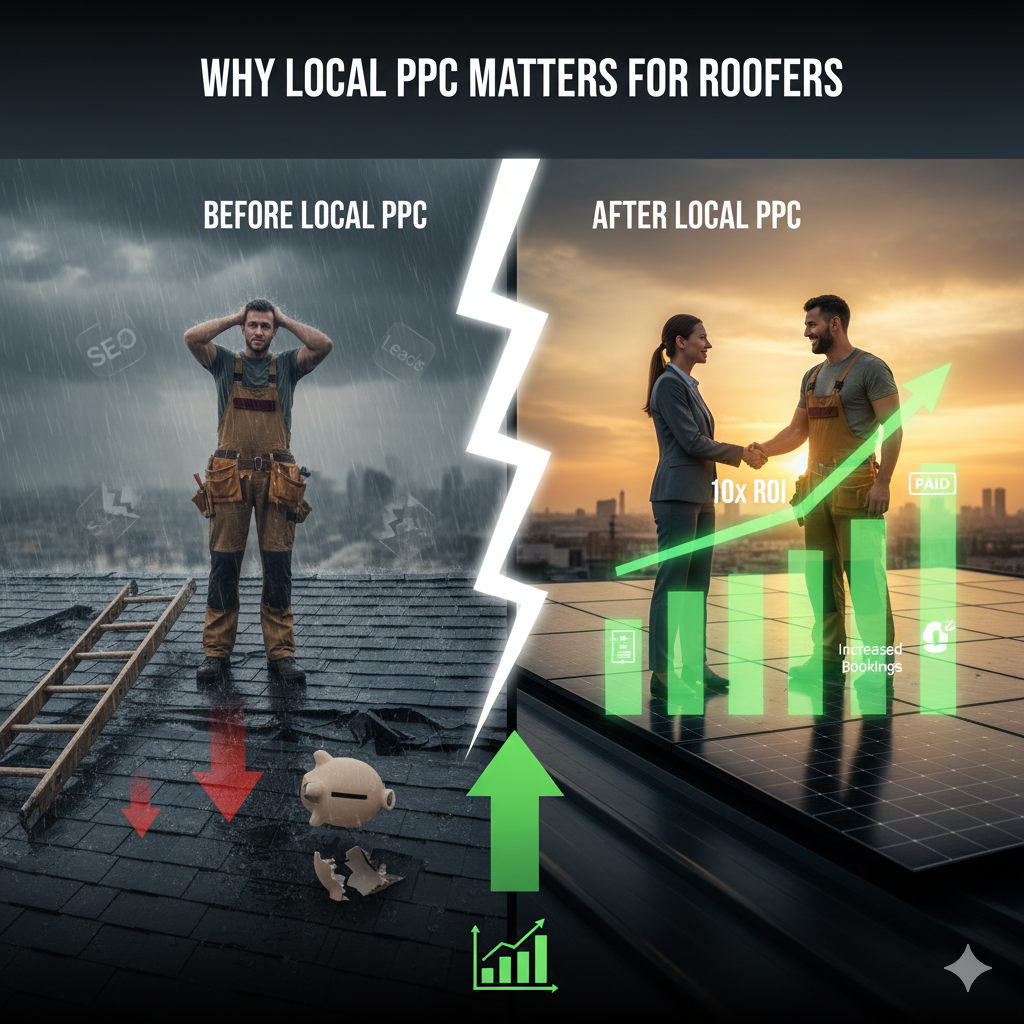

Imagine this scenario: a homeowner on your block just noticed a leak after last night’s storm. They pull out their phone, type “roof repair near me,” and—boom—your ad pops up, sleek and urgent. That’s the power of local PPC (pay‑per‑click). For roofing professionals, local PPC isn’t just marketing—it’s the difference between being the first phone call or getting lost in the shuffle.
Need Help With Your Marketing or Website?
Not getting enough leads or sales? Get a free consultation and discover how to improve your website and marketing.
- Find out what may be stopping visitors from contacting you
- Discover where your website or marketing could perform better
- Get clear recommendations to improve leads, calls, and conversions
This post will walk you through how roofers can leverage local PPC to dominate their service area, attract high‑intent leads, and drive real revenue. We'll cover everything—from campaign setup and audience targeting to ad copy, keyword strategy, negative keywords, geo-fencing, budget optimization, and tracking ROI. Let’s get started.
1. Define Your Service Territory with Precision
Why hyper-local boundaries matter
Roofing services are inherently local: you sell peace of mind, convenience, and quick response. Drawing too wide a boundary dilutes your budget; too narrow and you lose opportunity. Think zip‑codes rather than cities. Segment your area by roof types, neighborhoods, or target neighborhoods hit by recent storms.
How to establish logical segments
- Start with a heatmap of your prior leads and jobs.
- Add radius targeting from your business address—e.g., 5 to 10 miles.
- Define priority zones (e.g. storm‑impacted neighborhoods) and secondary zones.
2. Choose the Right PPC Platform for Maximum Reach
Google Ads: Still king for search
People search “emergency roof repair,” “roof leak solutions,” or “roofing contractors near me” when they need help fast. Google Ads remains the highest‑intent platform, especially for home services.
Microsoft's Bing & Yahoo: Lower competition, lower CPCs
Bing often delivers lower costs and attracts older homeowners—valuable for roofers with budgets to test secondary platforms.
Facebook Local Awareness Ads: Visual and service‑prompting
Use Facebook to retarget website visitors with before‑and‑after shots of completed jobs. Pair visuals with copy like “Storm damage? We’re in your neighborhood now.”
3. Craft High‑Converting Ad Copy That Feels Sharp, Real, and Human
Ad headline examples
- Emergency Roof Repair in [Neighborhood] – Available Today
- Local Roofing Specialists — Fast, Trusted, Free Estimate
Description examples
- “Storm leaves your roof calling for help? We’re your trusted local roofing team—rapid response within hours & no‑obligation quote.”
- “From missing shingles to full replacement, our certified crew in [City] handles it all with precision. Call now!”
Tips for authenticity and trust
- Use “we” and “your” to sound personal.
- Mention response guarantees: “within hours.”
- Include local cues: “in [Neighborhood],” “within [Zip].”
- Add credentials: “GAF Certified,” “BBB‑A+ Rated.”
4. Keyword Strategy: Focus on Long‑Tail + Local Intent
Why long‑tail local keywords win
Long-tail queries like “leaky flat roof repair near downtown [City]” carry high purchase intent. You're targeting highly specific needs—where ad dollars pay you back fast.
Suggested structure / examples
| Intent Stage | Example Keywords |
|---|---|
| Emergency repair | “emergency roof repair near me” |
| Material-specific | “metal roof replacement [City]” |
| Service-specific | “roof leak diagnosis in [Zip]” |
| Neighborhood focus | “roofing contractor in [Neighborhood]” |
Use dynamic keyword insertion to tailor headlines like:
“Emergency Roof Repair in {KeyWord:Your Area}”
5. Build Negative Keyword Lists to Eliminate Waste
Roofers often see wasted impressions on queries like “DIY,” “cheap,” “jobs hiring,” “school roofing curriculum”—so prune these.
Examples to exclude:
- DIY, tutorial, how to
- Cheap, low budget, if you're just shopping around
- Jobs, careers, training
- Videos, PDF, article
Over time, add search queries from your Search Terms report that drain your budget with no conversions. Refinement is ongoing.
6. Geo‑Targeting: Maximize Relevance, Minimize Waste
Radius targeting plus exclusions
For a storm-hit zone, set a 10‑mile radius but exclude neighborhoods too far or with no-past conversions. Use the “pin‑drop radius” feature in Google Ads.
Dayparting & schedules
Roofing emergencies usually happen Monday–Friday, daylight hours. Pause ads at night unless you offer 24‑hr emergency service. That saves budget and boosts performance.
Ad scheduling best practice
- Weekdays: 7 AM–7 PM (peak homeowner activity).
- Weekends: 9 AM–3 PM (lighter but still relevant).
- Use bid adjustments (e.g. +20% during storm week).
7. Set Budget and Bids Strategically
Start conservatively, then scale
Begin with $30–$50/day localized spend. Monitor CPC, CTR, conversion rates.
Smart bidding options
Use Maximize Conversions or Target CPA (e.g. target $50–$75 acquisition cost). Once you have data (~10 conversions), switch to enhanced CPC or Target ROAS if you tie in value (e.g. average job $1,500).
Allocate by zone
If Zone A delivers more leads, shift 60% of budget there and 40% to test secondary zones.
8. Landing Page Must-Haves: Convert Clicks to Jobs
Local credibility & clarity
- Prominently display your phone number, framed as “Roofers near [City].”
- Include real before/after photos, client testimonials with zip‑codes fo “Davao City,” “Talomo,” or relevant local references.
- Show certifications like “Philippine Contractors Association” or “GAF Certified.”
- Simplicity: one-click call-to-action (CTA) or lead form above the fold.
Trust badges & social proof
- “BBB‑A+” or “Philippine Red Cross roofing support” (if any local endorsements).
- “Licensed & Insured.”
- Live chat (e.g., “Text to schedule within 5 mins”).
9. Tracking & Attribution—Know What Works
Conversion tracking essentials
- Set up Goals for “Submitted Quote Form,” “Call Click,” and “Click to Call.”
- Use Google Ads + Analytics integration to monitor cost per lead, bounce rate, and time on page.
Offline conversion imports
If many leads come from phone calls leading to booked jobs, import final closed-job data back into Google Ads. This way, you optimize for true job value—not just form fills.
Call tracking tools
Use local number insertion tools (like CallRail, or Filipino-equivalent) to track which ads drive phone calls. Match call duration or converted jobs back to keywords.
10. Continuous Optimization: Refine, Refocus, Scale
Weekly check-ins
- Monitor search term reports; prune irrelevant queries.
- Adjust bids for high‑performing zones.
- Add new location-specific long-tail keywords like “broken shingle roof repair near [Barangay X].”
Monthly expansion
- A/B test ad variations: try adding emergency appeals vs. free estimates.
- Test new platforms: launch small Bing campaigns, or a Facebook retargeting push with carousel of your best jobs.
Quarterly strategy refresh
- Review conversion data: maybe 70% of your jobs come from roof replacements, so shift keywords like “roof replacement contractor near me.”
- Increase budget in zones with highest ROI—especially after major weather events.
Real Story: How a Filipino Roofer Doubled Leads in One Month
Consider Davao Roofing Pros (a small local contractor). After the monsoon season, they:
- Mapped out key barangays in Davao City with high job frequency.
- Launched a Google Ads campaign with “Davao roof leak emergency,” “roof replacement Toril,” “tarpaulin installation Buhangin.”
- Set negative keywords like “how to,” “DIY,” “jobs hiring.”
- Created localized landing pages for each barangay with neighborhood photos, badge of “Licensed by the Davao City Engineering Office,” local testimonials.
- Added call-tracking with a local 0995‑number to trace phone leads.
Results: Within 30 days they saw:
- 120% increase in click-through rate (CTR).
- 85% improvement in conversion rate on Barangay-specific landing pages.
- Cost per lead dropped from ₱1,200 to ₱750.
- Enough leads to book out 2 months in advance.
They then rolled out a Bing campaign targeting senior homeowners at lower CPC, further lowering average cost per booking.
Conclusion: Take Local PPC from “Just Another Ad” to Your Roofing Revenue Engine
In today’s competitive roofing market, being visible equals being viable. With a sharp local PPC strategy—complete with long‑tail geo‑targeted keywords, thoughtful negative keyword filtering, high‑trust ad copy, responsive landing pages, and tight tracking—you can capture high‑intent leads ready to book NOW.
Start by narrowing your service area and understanding what makes your local audience click. Then build ads that mirror their urgency (“Storm damage? Call by 5 PM”). Continuously refine keywords and bidding, and use real job data—not just clicks—to optimize. Within weeks, you'll not only show up—you'll dominate.