

Growing a multi-location business is rewarding—but undeniably complex. Whether you manage several retail stores, restaurants, healthcare centers, warehouses, gyms, or service branches across different regions, you know the truth: every location runs slightly differently, has its own challenges, and demands consistent oversight.
Yet relying on generic, one-size-fits-all software often leads to slowdowns, data inaccuracies, and operational disconnects that hold your growth back. That’s where custom software steps in—not as a luxury, but as a necessity for multi-location companies aiming for seamless efficiency and rapid scalability.
In today’s hyper-competitive landscape, adopting tailored software solutions can mean the difference between chaotic operations and a thriving, well-coordinated business network. Let’s explore why.
Why Multi-Location Businesses Face Unique Challenges That Generic Software Can’t Solve
Running one business location successfully is an achievement. Running five, ten, or fifty locations requires a new level of operational precision. Generic off-the-shelf software often fails because it:
- Lacks features specific to your workflows
- Restricts how data is shared
- Doesn’t integrate with your existing systems
- Doesn’t scale well as you add locations
- Forces your teams to “work around” the software instead of working with it
This results in inconsistent customer experiences, frustrated employees, and costly inefficiencies.
Custom software solves these pain points by building technology around your business—not the other way around.
How Custom Software Transforms Multi-Location Operations
1. Centralized Data Management for Real-Time Decision-Making
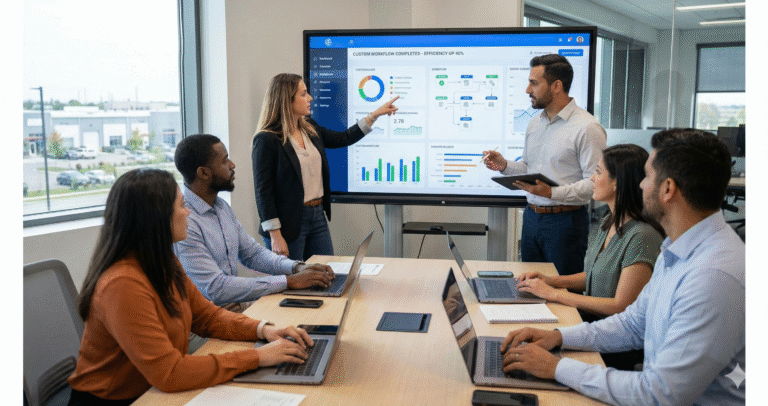
One of the biggest challenges multi-location businesses face is data spread across different tools, spreadsheets, and local systems. Custom software unifies all of it into a centralized dashboard where leadership can instantly access:
- Sales performance
- Inventory levels
- Employee productivity
- Customer behavior
- Operational alerts
- Financial reports
This shift from fragmented information to a single source of truth allows leaders to make faster, smarter decisions supported by real-time insights.
Need Help With Your Marketing or Website?
Not getting enough leads or sales? Get a free consultation and discover how to improve your website and marketing.
- Find out what may be stopping visitors from contacting you
- Discover where your website or marketing could perform better
- Get clear recommendations to improve leads, calls, and conversions
2. Consistency Across All Locations Without Losing Local Flexibility
Brand consistency keeps customers loyal—but different locations may need special workflows or custom processes.
Off-the-shelf tools treat every location the same, which creates friction.
Custom software allows you to:
- Standardize core processes (billing, reporting, communication)
- Allow location-specific customizations
- Adapt the platform to regional laws and regulations
- Manage multi-language support
- Offer unique features where needed
This balance of consistency and local personalization is almost impossible with pre-built software.
3. Seamless Communication and Collaboration Across Teams
When employees across different branches can’t communicate fluidly, operations slow down. Custom software can include:
- Internal messaging
- Shared calendars
- Task tracking
- Multi-location project boards
- Automatic notifications
- Centralized document management
This eliminates confusion and keeps every team aligned, productive, and accountable.
4. Integrated Systems That Eliminate Double Entry and Human Error
Multi-location businesses often use multiple disconnected tools—POS, CRM, HR, inventory, accounting, marketing platforms, and more.
Custom software integrates these into a unified ecosystem, ensuring:
- Automatic data syncing
- Accurate reporting
- Streamlined workflows
- Faster employee onboarding
- Reduced administrative time
When systems “talk” to each other, your business runs smoother.
5. Scalable Solutions That Grow With Your Business
Generic software often becomes limiting once your business grows past a certain number of locations—or adds new services. Custom tools are built with scalability in mind.
Your software can grow to include:
- New locations
- New service types
- New features
- New workflows
- Additional user roles
- More complex data tracking
Rather than replacing software every time you expand, custom solutions evolve with your business.
6. Enhanced Customer Experience at Every Touchpoint
Consistency is a hallmark of successful multi-location brands. Custom software ensures uniform customer experiences from one location to the next by providing:
- Integrated loyalty programs
- Personalized recommendations
- Faster checkouts
- Seamless appointment scheduling
- Accurate order tracking
Happy customers stay longer, spend more, and become brand ambassadors.
7. Cost Savings and Higher ROI Over Time
While custom software requires investment upfront, it pays for itself by dramatically reducing:
- Labor hours
- Administrative mistakes
- Software subscription costs
- Training time
- Operational waste
- Slowdowns caused by disconnected systems
Plus, once you own the software, you’re free from the long-term monthly fees associated with third-party platforms.
Key Features Multi-Location Businesses Should Include in Custom Software
To maximize impact, a strong custom platform should include:
✓ Multi-location dashboards
Monitor every branch from one interface.
✓ Role-based user access
Give the right people the right level of control.
✓ Automated workflows
Eliminate repetitive tasks that drain hours.
✓ Custom reporting and analytics
Focus on the KPIs that matter to your industry.
✓ Cloud-based access
Allow secure logins from anywhere.
✓ Inventory and asset management
Reduce shortages, overstock, and waste.
✓ POS or billing integrations
Ensure financial accuracy across all locations.
✓ Customer relationship tools
Track interactions, purchases, feedback, and loyalty.
✓ HR and staff management features
Schedules, timesheets, performance—centralized.
The more customized your operational needs, the more powerful your software becomes.
Real-World Example: The Difference Custom Software Makes
Imagine managing a chain of 12 retail stores.
With generic software, each store:
- Tracks inventory differently
- Uses its own spreadsheets
- Communicates inconsistently
- Creates separate monthly reports
- Handles customer issues without central documentation
Leadership spends hours trying to merge data and identify problems—and issues slip through the cracks.
With custom software:
- All inventory updates in real time
- All sales funnel into one reporting dashboard
- All staff schedules align across locations
- Customer profiles follow them from one store to another
- Managers receive automated insights and alerts
Suddenly, the entire business runs like a well-oiled machine.
Why Now? The Growing Importance of Custom Software in 2025
The technology landscape is shifting faster than ever. Multi-location businesses face new challenges:
- Higher customer expectations
- Increased competition
- More complex supply chains
- Emerging AI and automation tools
- Demand for real-time analytics
Custom software gives companies a competitive edge by:
- Enhancing adaptability
- Improving accuracy
- Supporting innovation
- Accelerating digital transformation
In 2025, businesses that rely on outdated tools fall behind—fast.
How to Get Started With Custom Software Development
If you're ready to move toward custom solutions, follow these steps:
1. Identify your biggest operational challenges
Start with pain points: reporting, communication, inventory, scheduling, data management, customer experience, or scaling.
2. Define your long-term goals
Do you plan to expand to new locations? Offer new services? Add new departments?
3. Partner with an experienced development team
Choose a firm that specializes in custom software for multi-location or multi-department operations.
4. Develop in phases
Start with a core version, then expand with additional features.
5. Test across a few locations first
Pilot testing ensures smooth adoption before full rollout.
6. Train your team and collect feedback
Continuous feedback leads to continuous improvement.
Final Thoughts: Custom Software Is No Longer Optional—It’s Strategic
Multi-location businesses face real operational complexity, and generic software simply can’t keep up. Custom software offers:
- Streamlined processes
- Improved team communication
- Better customer experiences
- Stronger data insights
- Lower long-term costs
- Scalable growth
Companies that invest in custom solutions position themselves for long-term success, increased profitability, and a stronger competitive edge in every market they serve.
If your multi-location business is ready to operate with greater consistency, visibility, and efficiency—custom software is the path forward.