
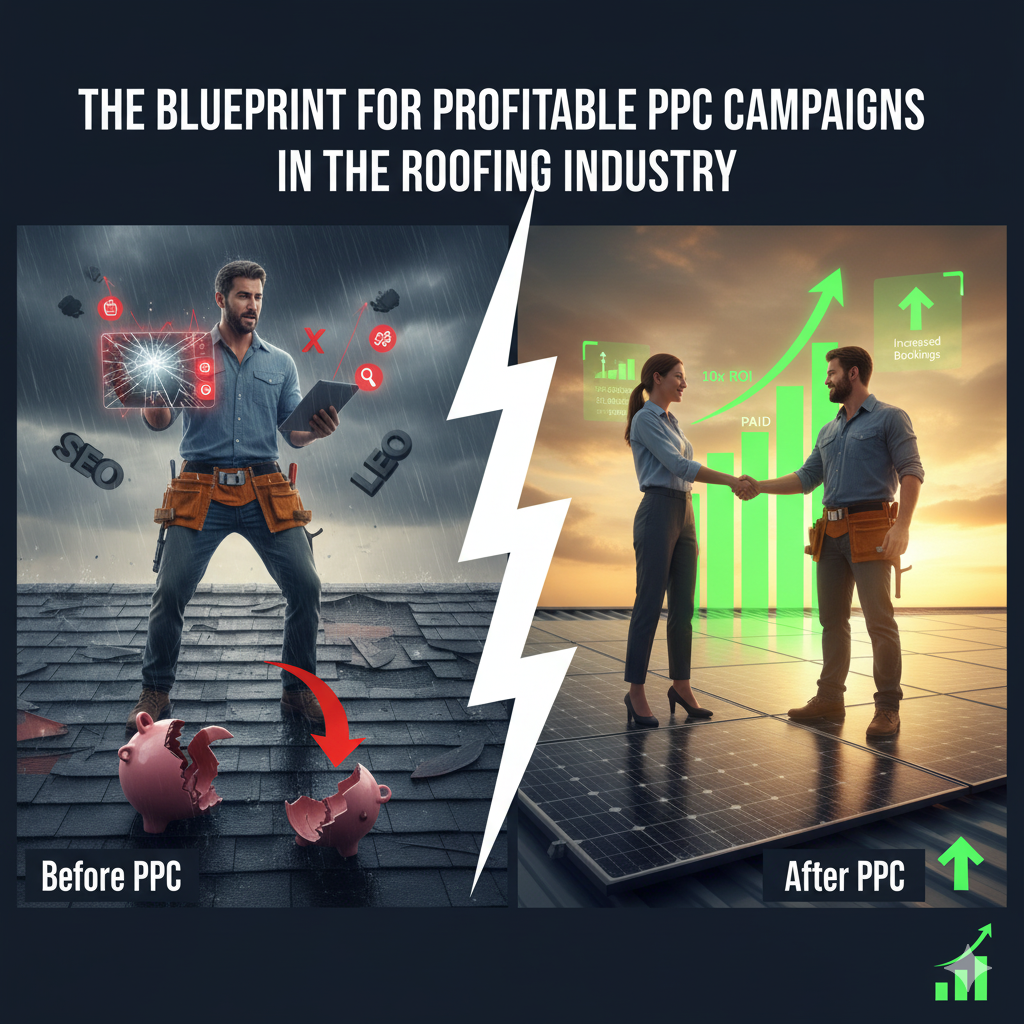

Introduction: Why Roofing PPC Campaigns Are Worth Your Investment
When it comes to digital marketing, the roofing industry may not be the first field that comes to mind—but that’s precisely why a well‑executed pay‑per‑click (PPC) campaign can yield tremendous returns. Roofing services are high‑value, locally driven, and urgently demanded—so customers are ready to act once they find you. In this post, we’ll walk through a blueprint for building highly profitable PPC campaigns, drawing from real‑world insights and best practices to help roofing contractors maximize ROI, minimize wasted spend, and consistently generate high‑quality leads.
Section 1: Understanding the “Why”—Profitability in Roofing PPC
1.1 Roofing PPC = High Intent, High Value
Most people searching for roofing services are facing urgent needs: a leak, storm damage, or a planned replacement. That urgency translates into high‑intent searches—so when you show up, you have a golden opportunity to convert them.
1.2 Local Targeting Means Precision Spending
Roofing contractors serve a defined territory. PPC platforms let you zone in tightly—down to ZIP code or radius. That precision helps ensure your ad spend is focused on the neighborhoods most likely to buy, cutting waste and improving ROI.
1.3 Tracking Metrics = Money Saved and Earned
With PPC, you can track conversions—calls, form fills, quote requests—and assign a clear revenue value. Roofing jobs often yield thousands in profit. If one more job a month covers the entire PPC budget, every click beyond that is gravy.
Section 2: Blueprint Step 1—Set Strategic Campaign Objectives
2.1 Define Clear, Revenue‑Oriented Goals
Instead of “increase clicks,” define goals like “generate 10 qualified roofing leads/month” or “book 5 free estimates every 2 weeks.” Tie each action back to revenue—e.g., average job value × close rate.
2.2 Choose the Right Campaign Types
- Search campaigns—essential for capturing high‑intent customers searching “roof repair near me.”
- Call‑only ads—great when mobile searchers need an immediate solution.
- Remarketing / display—effective for follow‑up, especially if someone researched you but didn’t convert.
Section 3: Blueprint Step 2—Keyword Strategy That Works for Roofers
3.1 Start with Broad Match Modified or Exact Match
Begin with tighter match types to control spend. “Roof repair in [your city]” is better than broad “roof repair”—it avoids irrelevant traffic.
3.2 Use Long‑Tail and Location‑Based Phrases
Think “emergency roof leak repair near downtown [City]” or “affordable shingle roof replacement in [ZIP].” These have lower competition and higher conversion intent.
3.3 Negative Keywords Are Your Friends
Eliminate clicks from searches like “roofing training,” “roofing software,” or “roofing jobs hiring.” Negative keywords keep your ads focused and your cost‑per‑conversion down.
Section 4: Blueprint Step 3—Compelling Ad Copy That Converts
4.1 Highlight Unique Selling Propositions (USPs)
“Same‑Day Estimates,” “Lifetime Warranty on Roof,” “Emergency Roofers 24/7”—these get attention.
4.2 Use Power Words and Clear CTAs
Words like “free,” “expert,” “trusted” combined with “call now,” “get a quote today” trigger action.
4.3 Add Local Flair and Social Proof
“In business since 1985,” “Rated 4.9 ⭐ by your neighbors in [City],” “Family‑owned roofing experts”—all build trust. Localized copy resonates deeper.
Section 5: Blueprint Step 4—Landing Pages Designed to Convert
5.1 Maintain Messaging Consistency
If the ad says “24-hour emergency roof repair,” the landing page should immediately reinforce that with headers like “We’re On Call Now.”
5.2 Keep the Form Simple and Visible
Limit fields: Name, Phone/Email, Brief Description + “Upload a photo” if possible. Place above the fold on mobile.
5.3 Add Trust Builders
Show badges (BBB, state license), testimonials, before‑and‑after photos, and an easy phone number click‑to‑call button. Testimonials like “Saved me thousands after the storm” help seal the deal.
Section 6: Blueprint Step 5—Geo‑Targeting & Scheduling for Maximum Efficiency
6.1 Optimize Location Settings
Target by radius, zip code, or communities where you know conversions are highest. Exclude areas with poor conversion history.
6.2 Day & Time Bid Adjustments
If emergency calls spike after storms or certain hours, increase bids during those windows. Review hour‑by‑hour conversion data weekly.
Section 7: Blueprint Step 6—Budgeting Smartly & Bidding Intelligently
7.1 Set a Realistic Minimum Budget
Even small campaigns—$500–$1,500 per month—can drive 10–30 qualified leads when setup correctly. Think relative to your job value and closing rate.
7.2 Use Smart Bidding Strategies
Start with Manual CPC or Enhanced CPC to gather data. As you collect conversion info, shift to Target CPA or Maximize Conversions—specify a realistic cost‑per‑lead goal.
7.3 Watch for “Click Inflation”
After storms, CPCs rise. Be ready to dial daily budgets down if cost per lead spikes. Don’t let short‑term competition bust your ROI.
Section 8: Blueprint Step 7—Conversion Tracking: Track Everything That Sells
8.1 Track Phone Calls With Dynamic Call Tracking
Show unique numbers on PPC ads and landing pages so you can attribute calls back to campaigns.
8.2 Track Form Submissions and Quote Clicks
Set up goals in Google Analytics or PPC platform—ensure each action is tracked as a conversion.
8.3 Assign Dollar Values to Leads
Even if not every lead turns into a job, you know your close rate. If 1 in 5 leads converts to a $6,000 job, each lead is worth $1,200. Input that into your PPC platform for deeper bidding automation.
Section 9: Blueprint Step 8—Continuous Testing and Optimization
9.1 A/B Test Ad Variations
Run two versions of headlines, descriptions, CTAs, USPs. Even small changes like “free roofing inspection” vs. “no‑cost roof evaluation” can shift performance.
9.2 Optimize Landing Pages
Test form placement, color schemes, page length, trust badges. Small lifts in conversion rate can drastically lower cost per lead.
9.3 Review Performance Weekly
Pause low‑performing keywords, double down on high‑performers, and adjust bids and budgets.
Section 10: Blueprint Step 9—Remarketing to Stay Top of Mind
10.1 Use Display or Search Remarketing Lists
People who visited your site but didn’t convert? Serve ads like “Still need a roofing quote? Get it free today.”
10.2 Adjust Ads Based on Behavior
Different messaging for someone who looked at “roof replacement” vs. “roof repair”—tailor copy to their intent.
10.3 Set Frequency Caps
Avoid ad fatigue by limiting impressions—a clean, respectful frequency (2–3/day) builds familiarity without annoyance.
Section 11: Blueprint Step 10—Scale Profitably and Sustainably
11.1 Expand with Care
Once one campaign targets “roof repair, [City],” create similar campaigns for “roof replacement,” “emergency tarping,” “insurance claims,” etc.
11.2 Diversify Platforms
Test Bing Ads, Facebook Local Awareness Ads, and Nextdoor to reach homeowners who aren’t actively searching—but might need you.
11.3 Document, Standardize & Delegate
Build a PPC “playbook”: keyword lists, ad templates, landing‑page frameworks, tracking setup, optimization checklist. This ensures consistency and opens the door to future delegation or agency partnerships.
Bonus: Real‑World Example (Illustrative)
Meet GreenPeak Roofing – a mid‑sized roofing company serving Suburbanville.
- They launched a Google Search campaign with “emergency roof tarp Suburbanville” and “storm damage roof repair Suburbanville.”
- Ads featured “Free Same‑Day Estimate • 4.9 ⭐ Local Experts.”
- Landing page had a one‑field form (“Phone or Email”) plus a click‑to‑call button and customer testimonial.
- Month 1: $800 spent → 20 form fills and 30 calls. Lead cost averaged ≈ $20.
- With a 20 % close rate and $5,000 average job lead value equated to $1,000 → 10 jobs booked → $50,000 in revenue. ROI: over 6×.
- Following that success, they added a campaign for “roof replacement financing options,” refined keywords, launched remarketing, and documented it in a playbook for their marketing manager to run.
In Summary
To build profitable PPC campaigns in the roofing industry, follow this blueprint:
- Set revenue‑driven goals
- Use precise, high‑intent keyword targeting
- Craft compelling, localized ad copy with clear CTAs
- Deliver conversion‑optimized landing pages
- Geo‑target and schedule smartly
- Budget strategically and test bidding methods
- Track conversions thoroughly, including calls
- A/B test ads and pages continuously
- Retarget past visitors with tailored messaging
- Scale methodically, diversify channels, and create standard playbooks
This approach turns each PPC dollar into measurable value—and over time, builds a reliable, scalable, profitable driver of roofing leads that outperforms nearly every other form of marketing.
Final Takeaways: Action Items for You Today
- Audit your current PPC campaigns against this blueprint. Where are the gaps—copy, location targeting, conversion tracking?
- Improve one thing this week—even tweaking ad copy or launching a remarketing list can shift conversions immediately.
- Set up call tracking and assign lead dollar values. Let the data speak for your decisions.
- Document your process—and watch your healthy PPC pipeline become your most dependable source of growth.