
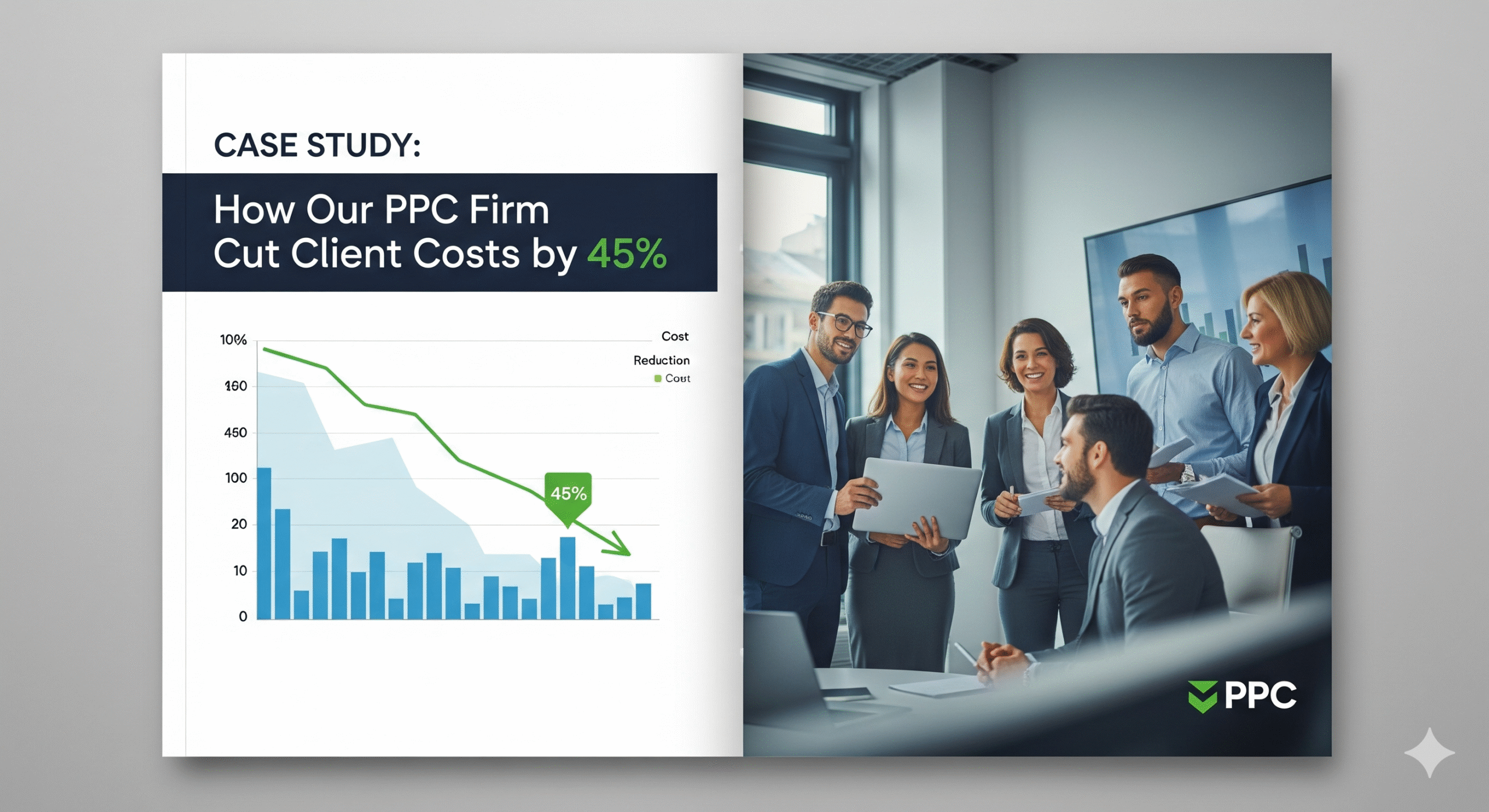

In today’s fiercely competitive digital advertising landscape, businesses face a constant challenge: how to maximize returns from their pay-per-click (PPC) campaigns without overspending. This case study unveils how our PPC firm managed to reduce a client’s advertising costs by an impressive 45%, while simultaneously improving campaign performance and ROI.
Introduction: The Challenge Our Client Faced
Our client, a mid-sized e-commerce company, was spending heavily on Google Ads but struggling with low conversion rates and escalating costs. Despite a reasonable budget, their cost-per-acquisition (CPA) was ballooning, and the return on ad spend (ROAS) was disappointingly low.
They approached us with a clear goal: optimize their PPC campaigns to cut unnecessary costs and generate more qualified leads without compromising on growth.
Step 1: Comprehensive PPC Audit – Identifying Inefficiencies
Our first step was a thorough audit of their existing Google Ads account and campaign structure. This involved:
- Analyzing keyword performance and identifying costly underperforming keywords.
- Evaluating ad copy effectiveness and relevancy scores.
- Scrutinizing bidding strategies and budget allocation across campaigns.
- Assessing landing page experience and conversion tracking setup.
We discovered several critical inefficiencies:
- Broad match keywords were attracting irrelevant traffic, wasting spend.
- Ad copy lacked differentiation and did not resonate with the target audience.
- The client’s manual bidding strategy was outdated, leading to overbidding.
- Poorly optimized landing pages caused a high bounce rate.
Need Help With Your Marketing or Website?
Not getting enough leads or sales? Get a free consultation and discover how to improve your website and marketing.
- Find out what may be stopping visitors from contacting you
- Discover where your website or marketing could perform better
- Get clear recommendations to improve leads, calls, and conversions
Step 2: Strategic Keyword Refinement and Negative Keyword Implementation
To curb wasteful spend, we refined the keyword list by:
- Shifting from broad match keywords to more precise phrase and exact match keywords to target high-intent searchers.
- Conducting extensive keyword research using tools like SEMrush and Google Keyword Planner to identify profitable, low-competition long-tail keywords.
- Implementing a robust negative keyword strategy to filter out irrelevant searches and prevent budget drain.
This approach immediately reduced irrelevant clicks by over 30%, ensuring ad spend was focused on genuinely interested prospects.
Step 3: Crafting Compelling Ad Copy That Converts
Next, we revamped the client’s ad creatives to improve click-through rates (CTR) and relevance scores:
- Created multiple ad variations tailored to different buyer personas.
- Included strong calls-to-action (CTAs) and value propositions that addressed pain points.
- Leveraged ad extensions such as sitelinks, callouts, and structured snippets to provide additional context and increase ad real estate.
After these changes, CTR improved by 25%, leading to higher Quality Scores and lower cost-per-click (CPC).
Step 4: Leveraging Smart Bidding and Automated Budget Allocation
We recommended transitioning from manual CPC bidding to Google’s Smart Bidding strategies:
- Utilizing Target CPA bidding to automatically adjust bids for conversions.
- Employing Target ROAS bidding for campaigns focused on maximizing revenue.
- Allocating budgets dynamically based on campaign performance data.
Automated bidding helped reduce wasted spend by optimizing bids in real time, contributing to the significant cost savings
Step 5: Enhancing Landing Page Experience to Boost Conversions
A seamless user journey from ad click to conversion is crucial. Our team collaborated with the client’s web development team to:
- Simplify landing page design, improving load speed and mobile responsiveness.
- Ensure messaging consistency with ad copy to reduce bounce rates.
- Incorporate clear and compelling CTAs backed by trust signals like reviews and guarantees.
These enhancements resulted in a 20% increase in conversion rates, amplifying the overall effectiveness of the PPC campaigns.
Results: Achieving a 45% Reduction in Client Costs
After 6 months of continuous optimization, the client achieved:
- A 45% reduction in total PPC ad spend.
- A 35% increase in conversion rates.
- A 50% improvement in ROAS.
- Enhanced lead quality and customer engagement.
This case study demonstrates that with the right strategy and expert execution, it’s possible to cut PPC costs drastically while improving campaign outcomes.
Key Takeaways for Businesses Looking to Optimize PPC Spend
- Audit and Analyze: Regularly review campaign data to spot inefficiencies.
- Focus on Intent: Use precise match types and negative keywords to attract qualified traffic.
- Test and Refine Ads: Continuously improve ad copy based on performance data.
- Leverage Automation: Smart bidding can optimize budget use more effectively than manual management.
- Enhance User Experience: Ensure landing pages align with ads and convert visitors.
Conclusion: Partner with Experts to Maximize PPC ROI
Reducing PPC costs by nearly half isn’t luck — it’s the result of strategic planning, ongoing optimization, and industry expertise. If your business struggles with rising PPC costs or low ROI, partnering with a dedicated PPC firm can unlock significant growth potential.
Contact us today to learn how our tailored PPC solutions can help you cut costs, boost conversions, and grow your business sustainably.