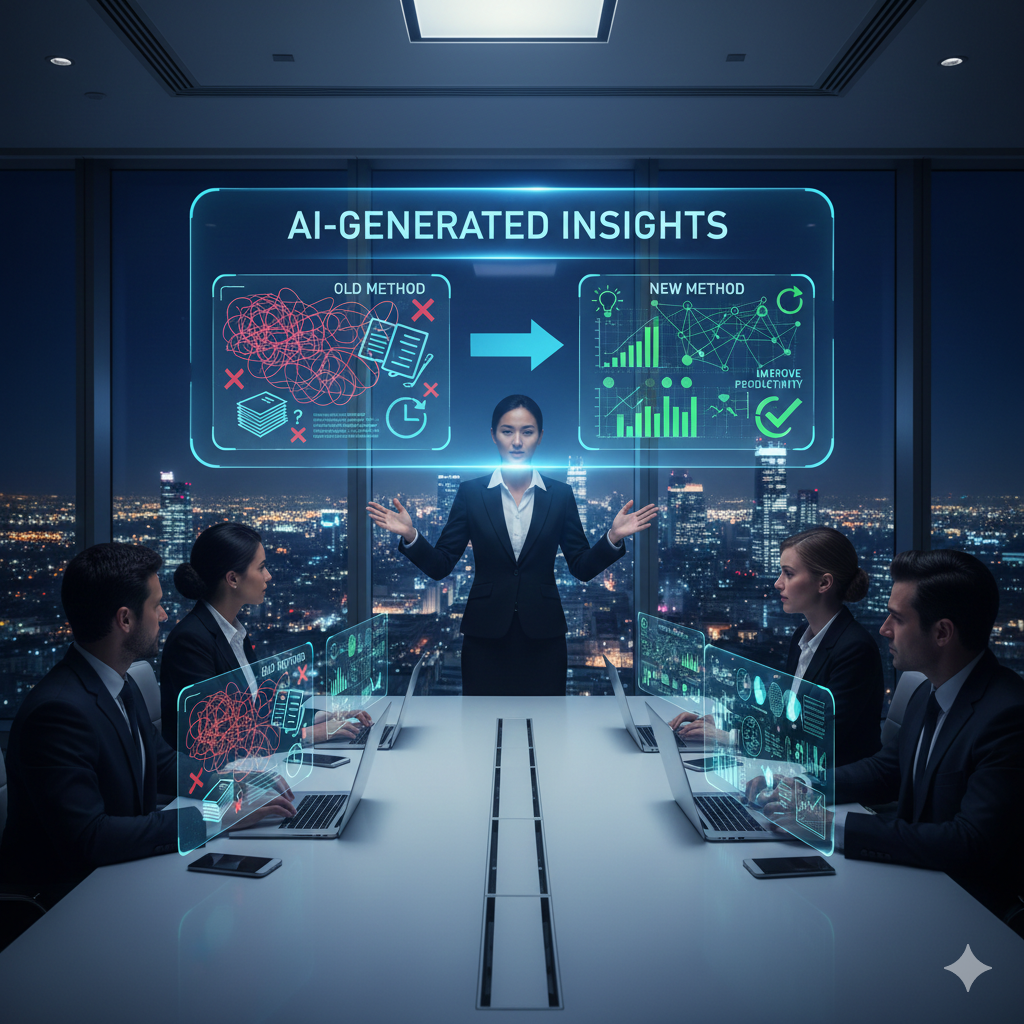

In today’s fast-moving digital economy, productivity is no longer about working harder — it’s about working smarter. Businesses that once relied solely on manual reporting, intuition, and historical analysis are now leveraging artificial intelligence to uncover patterns, forecast trends, and drive strategic decisions in real time.
AI-generated insights are transforming how organizations operate, compete, and grow. From automating routine analysis to predicting customer behavior, AI enables teams to focus on high-impact tasks instead of repetitive work. The result? Faster decisions, fewer errors, better outcomes — and significantly improved productivity.
Let’s explore in depth why AI-generated insights are becoming the backbone of high-performing teams and forward-thinking businesses.
How AI-Generated Data Analysis Reduces Manual Work and Saves Time
One of the biggest productivity drains in any organization is manual data processing. Employees often spend hours collecting spreadsheets, reconciling reports, and trying to interpret trends. This approach is not only time-consuming but also prone to human error.
AI-powered analytics tools can automatically:
- Aggregate data from multiple systems
- Clean and structure information
- Identify anomalies
- Highlight actionable trends
Instead of dedicating days to compiling reports, teams receive instant dashboards with key insights. This automation dramatically reduces administrative overhead and allows professionals to shift their focus toward strategy and execution.
Time saved equals productivity gained.
Real-Time Business Intelligence for Faster Decision-Making
Traditional reporting cycles operate on weekly or monthly timelines. In contrast, AI systems analyze live data streams and generate insights instantly.
Real-time insights empower organizations to:
- Detect operational bottlenecks immediately
- Adjust marketing campaigns mid-flight
- Respond to customer behavior changes instantly
- Optimize pricing dynamically
When leadership can act on current information instead of outdated reports, productivity accelerates across departments. Decisions are no longer reactive — they become proactive.
Need Help With Your Marketing or Website?
Not getting enough leads or sales? Get a free consultation and discover how to improve your website and marketing.
- Find out what may be stopping visitors from contacting you
- Discover where your website or marketing could perform better
- Get clear recommendations to improve leads, calls, and conversions
Predictive Analytics That Anticipate Problems Before They Occur
One of the most powerful ways AI improves productivity is through predictive analytics.
Rather than simply reporting what happened, AI models forecast what is likely to happen next. For example:
- Sales teams can predict which leads are most likely to convert
- HR departments can identify employees at risk of burnout
- Supply chains can anticipate inventory shortages
- Customer service teams can foresee spikes in support tickets
By anticipating challenges early, organizations prevent costly disruptions. Preventative action reduces downtime, minimizes stress, and maintains workflow continuity.
Enhancing Employee Focus by Eliminating Cognitive Overload
Modern professionals are inundated with data — dashboards, notifications, emails, reports, and KPIs. The sheer volume of information can lead to decision fatigue and reduced performance.
AI-generated insights solve this by filtering noise and highlighting what truly matters.
Instead of reviewing dozens of metrics, employees see:
- The top 3 performance drivers
- Key risk indicators
- Actionable recommendations
- Priority tasks ranked by impact
This clarity enhances focus and boosts productivity by ensuring that effort is directed toward high-value activities.
Automating Repetitive Operational Tasks With Intelligent Systems
Repetitive processes often consume a significant portion of work hours. Tasks like data entry, categorization, document sorting, and basic reporting add little strategic value.
AI systems can automate:
- Invoice processing
- Email routing
- Lead scoring
- Performance reporting
- Customer segmentation
When repetitive tasks are handled by intelligent automation, employees reclaim time for creative problem-solving, innovation, and collaboration.
Automation does not replace human expertise — it amplifies it.
Improving Marketing Campaign Performance Through AI Insights
Marketing productivity improves dramatically when AI-generated insights are applied to campaign strategy.
AI tools analyze customer behavior, engagement metrics, and historical data to determine:
- Optimal posting times
- Most effective content formats
- High-performing audience segments
- Predictive lifetime value
Instead of guessing which campaign will succeed, marketers rely on data-driven strategies. This reduces wasted ad spend and increases ROI.
More accurate targeting means less trial and error — and higher productivity.
Optimizing Workforce Management With Intelligent Performance Analytics
AI-generated insights are reshaping workforce optimization. Managers can now identify patterns in employee performance, engagement, and workflow efficiency.
Examples include:
- Recognizing peak productivity hours
- Identifying workload imbalances
- Detecting collaboration gaps
- Measuring output trends over time
With these insights, leaders can allocate resources more effectively and create environments that support sustained performance.
A data-informed workforce strategy leads to improved morale and measurable productivity gains.
Reducing Human Error Through Data-Driven Accuracy
Human error is inevitable when dealing with complex datasets. Misinterpretation, oversight, and bias can lead to flawed decisions.
AI systems process massive volumes of information consistently and objectively. By reducing manual intervention in data analysis, organizations lower the risk of:
- Reporting inaccuracies
- Financial miscalculations
- Operational inefficiencies
- Compliance violations
Improved accuracy directly contributes to smoother operations and fewer corrective actions — both of which enhance productivity.
Personalized Customer Experiences That Increase Operational Efficiency
AI-generated insights enable hyper-personalized customer interactions. When businesses understand customer preferences and behaviors at scale, they can tailor communications automatically.
Benefits include:
- Faster response times
- More relevant product recommendations
- Improved customer satisfaction
- Higher retention rates
Serving customers efficiently reduces repetitive service interactions and increases team productivity. When customer needs are anticipated and met quickly, overall operational load decreases.
Strategic Resource Allocation Based on Intelligent Forecasting
AI insights allow leaders to make smarter resource allocation decisions. Instead of relying on static budgets and assumptions, organizations can dynamically adjust investments based on data trends.
For example:
- Scaling advertising spend toward high-converting channels
- Increasing staffing during forecasted demand spikes
- Prioritizing product features with highest engagement metrics
Optimized allocation prevents wasted effort and ensures that resources are deployed where they generate maximum value.
Cross-Department Collaboration Powered by Unified Data Insights
Productivity often suffers when departments operate in silos. Sales, marketing, operations, and finance may rely on different data sources, leading to conflicting strategies.
AI platforms integrate cross-functional data and present unified insights. When teams work from a single source of truth:
- Communication improves
- Alignment strengthens
- Redundant efforts decrease
- Strategic goals become clearer
Collaboration becomes more efficient when everyone operates from the same intelligent insights.
Scalability Without Proportional Workforce Expansion
One of the most compelling advantages of AI-generated insights is scalability. As businesses grow, the volume of data increases exponentially.
Without AI, scaling often requires:
- More analysts
- More manual reporting
- More administrative oversight
With AI-driven systems, organizations can handle larger datasets and more complex operations without proportional increases in staff. This enhances productivity per employee and strengthens long-term growth potential.
Continuous Learning Systems That Improve Over Time
Unlike static reporting systems, AI models continuously learn from new data. This means insights become more refined and accurate over time.
As patterns evolve, AI adapts. This ongoing improvement ensures that businesses remain agile and competitive in changing markets.
A system that learns and optimizes itself contributes to sustained productivity gains.
Real-World Applications of AI-Generated Productivity Improvements
Across industries, AI-generated insights are driving measurable improvements:
- Retail companies optimize inventory turnover
- Healthcare providers improve patient scheduling efficiency
- Financial institutions detect fraud faster
- Manufacturing plants reduce downtime through predictive maintenance
- E-commerce platforms increase conversion rates through personalization
The productivity impact is not theoretical — it is practical and measurable.
Building a Culture That Embraces Data-Driven Productivity
Technology alone does not guarantee productivity gains. Organizations must cultivate a culture that values data-driven decision-making.
Key steps include:
- Training teams to interpret AI insights
- Encouraging experimentation
- Aligning KPIs with actionable metrics
- Promoting transparency in analytics
When employees trust and understand AI-generated insights, adoption increases — and so does productivity.
Overcoming Common Misconceptions About AI in the Workplace
Some professionals fear that AI will replace human roles. In reality, AI enhances human capabilities.
AI handles data-heavy tasks, while humans focus on:
- Creativity
- Strategic thinking
- Relationship building
- Innovation
The synergy between intelligent systems and human expertise drives productivity to new heights.
The Future of Productivity Is Insight-Driven
As digital transformation accelerates, organizations that leverage AI-generated insights will outperform those that rely on outdated processes.
Productivity in the modern era is defined by:
- Speed of insight
- Accuracy of analysis
- Precision of execution
- Ability to adapt
AI-generated insights provide all four.
Businesses that embrace intelligent analytics are not just improving efficiency — they are building resilient, future-ready organizations.
Conclusion: Turning Data Into Action for Sustainable Productivity Growth
AI-generated insights improve productivity by eliminating manual inefficiencies, enabling faster decisions, predicting future challenges, and enhancing strategic alignment. They empower teams to focus on what truly matters while automation handles complexity behind the scenes.
In an increasingly competitive landscape, the ability to transform raw data into actionable intelligence is no longer optional. It is essential.
Organizations that integrate AI-driven insights into daily operations will experience higher efficiency, better outcomes, and sustained growth — not by working more, but by working smarter.